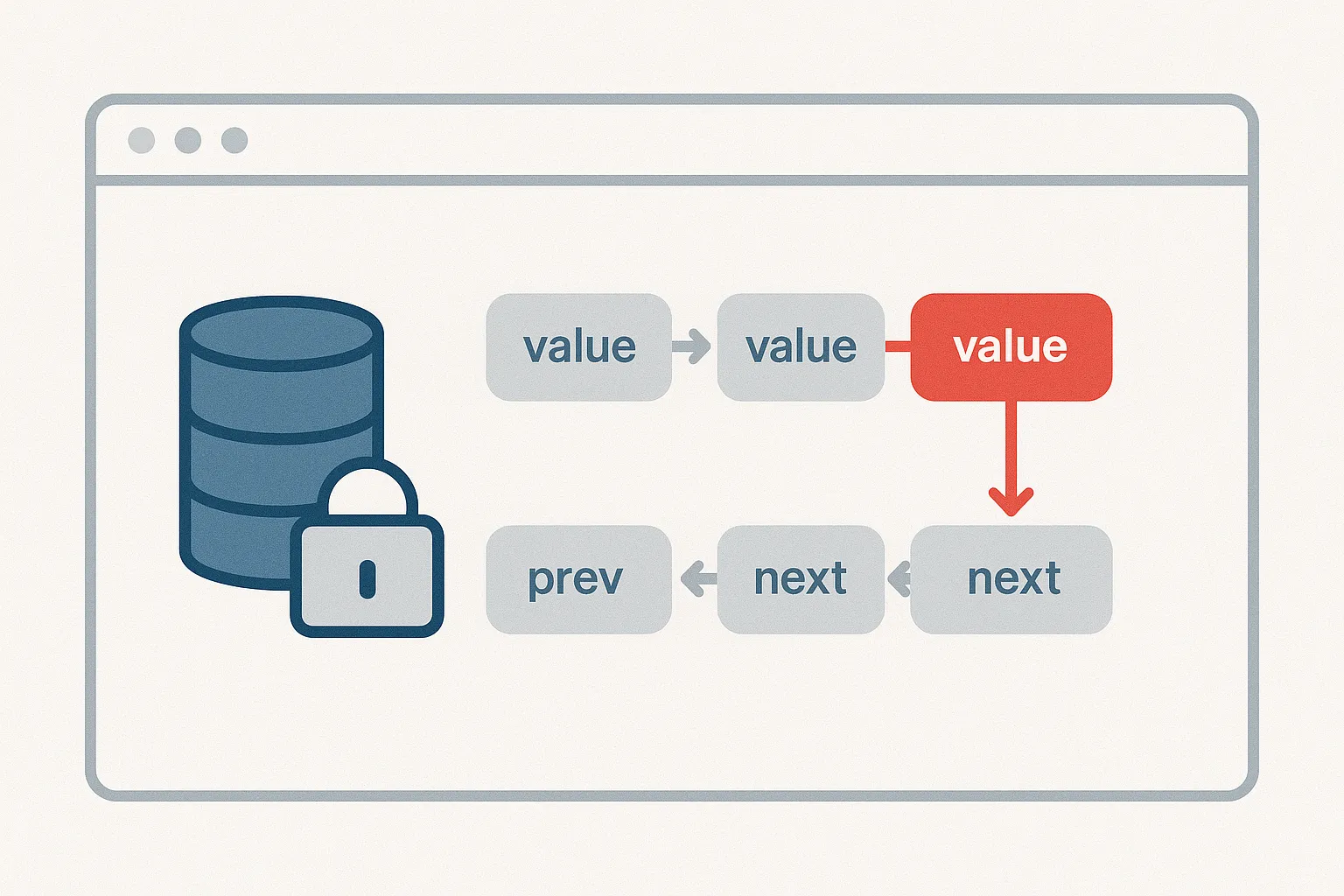
Note (2025) This post is part of a brief CS Fundamentals / DSA series. Linked lists rarely appear in day-to-day Rails/web work, but they’re still foundational for interviews and for understanding how higher-level containers work under the hood. If you prefer strictly application-engineering topics, feel free to skip—but if you’re brushing up for interviews or low-level systems work, this might help.
Table of Contents
Open Table of Contents
What is a linked list?
A linked list is a linear collection of elements (nodes) where each node holds:
- a value, and
- a reference (link) to the next node (and optionally the previous node).
Unlike arrays, linked lists don’t require contiguous memory; nodes can live anywhere in memory, connected by references.
Flavors
- Singly linked list (SLL): each node points to next.
- Doubly linked list (DLL): each node points to prev and next.
- Circular variants link the tail back to the head.
Why (and when) to use one?
Pros
O(1)insertion/deletion at head (and tail, if you keep a tail pointer).- No large contiguous memory requirement.
- Stable references to nodes even as the list grows.
Cons
O(n)random access; you must traverse from head.- Extra memory per node for pointers.
- Worse cache locality than arrays.
Typical uses
- Implementing queues/deques/LRU caches (often DLL + hash map).
- Adjacency lists in graphs.
- Streaming scenarios where you frequently push/pop at ends.
Core Operations (singly linked list)
Below is minimal, language-agnostic pseudocode; adapt easily to Ruby, Python, or JS.
Node
class Node:
  value
  next
Insert at head — O(1)
def push_front(head, value):
  node = Node(value)
  node.next = head
  return node  # new head
Insert after a node — O(1)
def insert_after(node, value):
  new_node = Node(value)
  new_node.next = node.next
  node.next = new_node
Delete after a node — O(1)
def delete_after(node):
  if node == null or node.next == null: return
  node.next = node.next.next
Search — O(n)
def find(head, target):
  cur = head
  while cur != null:
    if cur.value == target: return cur
    cur = cur.next
  return null
Doubly Linked List essentials
A DLL node stores prev and next:
class Node:
  value
  prev
  next
Benefits
O(1)delete from the middle when you already hold a node reference (update both neighbors).- Natural fit for LRU and deque operations.
Trade-off
- Slightly more memory and pointer bookkeeping.
Complexity & Trade-offs
| Operation | SLL | DLL | Array (dynamic) |
|---|---|---|---|
| Access k-th element | O(n) | O(n) | O(1) |
| Insert at head | O(1) | O(1) | O(n) (shift) |
| Insert at tail (with tail ptr) | O(1) | O(1) | Amortized O(1) |
| Delete given a node ref | O(1) | O(1) | O(n) (shift) |
| Memory overhead per element | pointer | 2 pointers | none extra |
| Cache friendliness | lower | lower | higher |
Rule of thumb: If you need frequent insertions/removals at the ends or you maintain node references, lists shine. For random access by index, arrays win.
When not to use a linked list
- You need frequent k-th element access by index.
- Your dataset is small and simpler array methods suffice.
- You depend heavily on CPU cache locality for performance.
Modern libraries often give you the right structure already (e.g., Deque, LinkedList, OrderedDict in various languages), implemented efficiently and tested—use them first.
In the real world (2025)
- Application code (Rails, web APIs) seldom needs hand-rolled lists. Built-in containers are faster and safer.
- Interviewers still ask list problems (reverse a list, detect cycles, merge k lists).
- Systems work (caches, schedulers, memory allocators) still relies on list-like structures behind the scenes.
Practice prompts
- Reverse a singly linked list (iterative & recursive).
- Detect a cycle (Floyd’s tortoise–hare).
- Delete a node in O(1) given only that node (SLL trick: copy next’s value, bypass next).
- Merge two sorted lists.
- Implement an LRU cache (DLL + hash map).
Wrap-up
Linked lists are a conceptual cornerstone. Even if you rarely write one from scratch in production, understanding their costs and benefits helps you pick the right container—and ace common interview tasks.